
8 Joint-Saving Strength Exercises Every Man Over 40 Should Be Doing

Trap Bar Deadlift
Goblet Squat (Tempo Controlled)
Romanian Deadlift (RDL)
Split Squat (Rear Foot Elevated Optional)
Isometric Holds (Wall Sits & Planks)
Loaded Carries (Farmer’s Walk)
Incline Push-Ups or Dumbbell Press
Rucking (Weighted Walking)
The reality is your 45-year-old joints are not a worn-out liability—they’re a system that’s been poorly managed. Most people don’t have a “bad knee” or a “bad back.” They have bad loading strategies, inconsistent inputs, and zero attention to mechanics.
If we’re going to keep lifting—and you should—we need to stop chasing fatigue and start engineering durability. The goal isn’t to survive workouts. The goal is to build hardware that can handle load for the next 40 years.
Below are eight movements that deliver a high return on investment without grinding your joints into dust. Minimum Effective Dose. Maximum structural integrity.
1. Trap Bar Deadlift

Here’s the data: most lower back issues in midlife come from poor leverage and excessive shear force. The trap bar fixes both.
- Neutral grip reduces spinal torque
- Centered load decreases shear stress on L5-S1
- More quad contribution, less ego-driven rounding
If you’ve ever "felt it in your back," this is your reset point.
2. Goblet Squat (Tempo Controlled)

The goblet squat is a diagnostic tool disguised as an exercise.
Slow it down—3 seconds down, pause, then up. You’ll expose mobility restrictions instantly.
- Reinforces upright torso mechanics
- Improves hip and ankle mobility
- Teaches proper bracing without spinal compression
3. Romanian Deadlift (RDL)

The hinge pattern is the backbone of functional strength. Most people butcher it.
The RDL teaches you to load the posterior chain without turning your lumbar spine into the primary mover.
- Targets hamstrings and glutes with precision
- Minimal knee stress
- Rebuilds proper hinge mechanics
4. Split Squat (Rear Foot Elevated Optional)

Unilateral work is not optional after 40—it’s mandatory.
Your body is asymmetrical. Your training should account for it.
- Reduces spinal load compared to bilateral squats
- Fixes left-right imbalances
- Improves knee tracking and stability
5. Isometric Holds (Wall Sits & Planks)
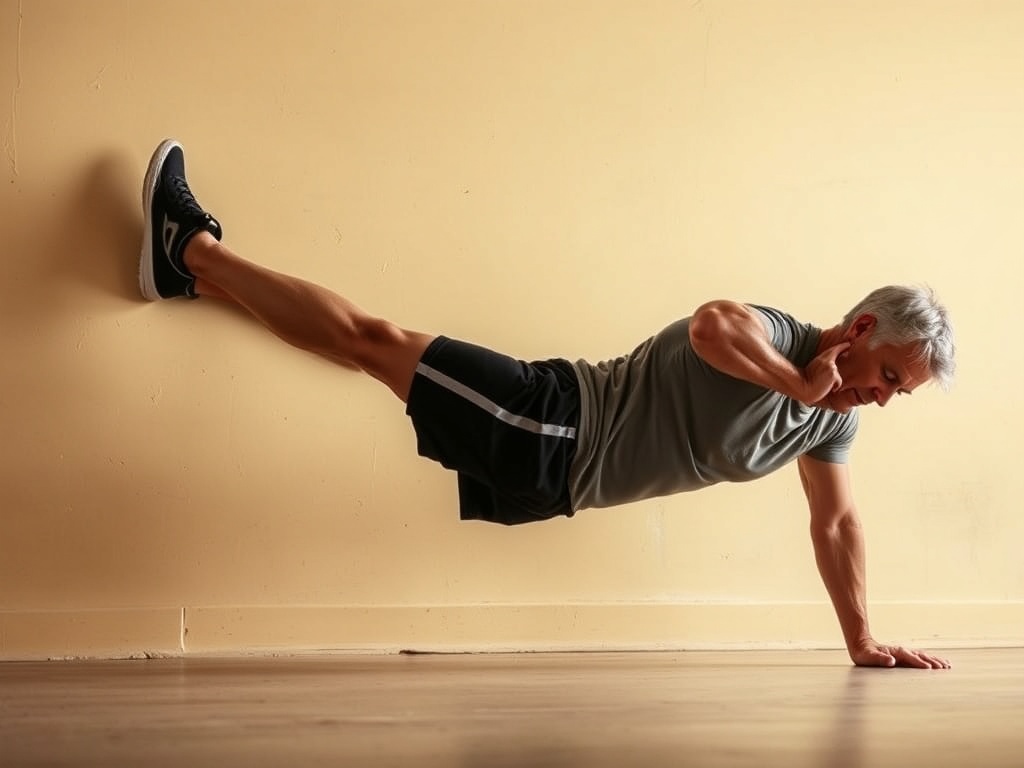
Isometrics are boring. They’re also one of the most underutilized tools for tendon health.
When joints feel "noisy," isometrics calm the system down while building resilience.
- Strengthens connective tissue without joint movement stress
- Improves joint stability
- Low fatigue, high benefit
6. Loaded Carries (Farmer’s Walk)

This is one of the closest things we have to real-world strength.
No machines. No isolation. Just load carriage.
- Builds grip, core, and postural integrity
- Teaches the body to stabilize under load
- Transfers directly to daily life
7. Incline Push-Ups or Dumbbell Press

Flat benching with ego weight is where shoulders go to die.
Adjust the angle. Control the load.
- Reduces shoulder strain
- Allows scalable progression
- Maintains pressing strength without joint abuse
8. Rucking (Weighted Walking)

If you ignore cardio after 40, your system degrades fast. But high-impact cardio is not the answer.
Rucking is.
- Low-impact cardiovascular training
- Builds bone density and work capacity
- Scales infinitely with load and distance
The System Update
You don’t need 20 exercises. You need the right ones, executed correctly.
- Train 3–4 times per week
- Prioritize form over load
- Log everything—if it’s not written down, it didn’t happen
- Keep 1–2 reps in reserve on most sets
The goal is not exhaustion. It’s adaptation.
Respect the hardware. Build the system. Then iterate.
Let’s get to work.