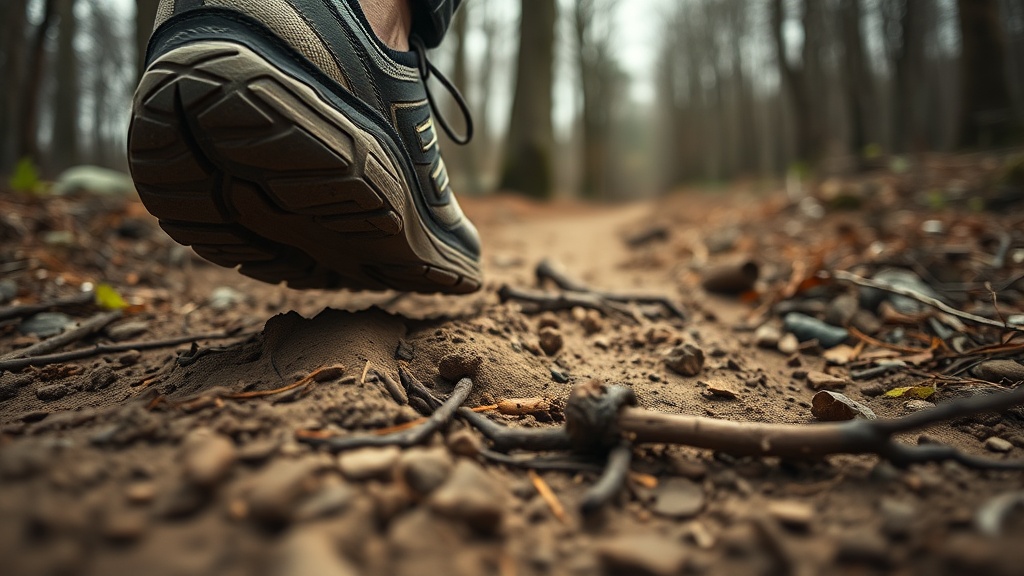
Engineering Your Spring Outdoor Transition: Why Your Gym Program Doesn't Translate

Here's the engineering problem nobody talks about when spring hits and everyone migrates outside.
Your gym program looks transferable. Same movements. Same load. Same perceived effort. But your knees are about to file a formal complaint, and you're not going to understand why until you've been limping for two weeks wondering what happened.
What happened is a hardware mismatch — and I've got the scar tissue to prove it.
The Hardware Mismatch (Why Gym Logic Fails Outdoors)
After my L5-S1 blew out at 39, I spent two years auditing everything about how I moved. One of the most clarifying things I learned: the gym is a deterministic environment. The outdoors is a stochastic one.
Inside a gym, the hardware is designed to isolate variables:
- Barbell rack: fixed path, predictable loading, your stabilizers are mostly spectators
- Treadmill: constant surface compliance, calibrated impact, zero lateral demand
- Cable machine: guided force vectors, the same angle every rep
Your central nervous system loves this. It outsources stabilizer recruitment, runs the prime movers hard, and calls it efficient. And it is efficient — for building raw strength in controlled conditions.
Step outside onto a grass field, a trail, or even an asphalt road with crowning and drainage variation, and the contract changes. The environment is now feeding your nervous system a continuous stream of micro-decisions: surface compliance shifting underfoot, unpredictable joint angles, variable force transmission on every stride.
A 225lb deadlift off a level gym floor is not the same as a 225lb Romanian deadlift on a grassy hillside. The external load is identical. The systemic demand is not.
Your stabilizers, which were happily off-duty inside, suddenly own a meaningfully larger share of the workload. And your CNS is now paying a tax it hasn't paid all winter.
The Ground Compliance Variable
Not all outdoor surfaces are created equal, and this is where most transition plans fall apart — people treat "outside" as a monolith.
Asphalt: High impact forces. Zero surface compliance. The ground doesn't absorb anything — all that force transmits straight up the kinetic chain. Anterior chain dominates (quads, hip flexors). Great for road speed work, brutal on unprepared joints.
Grass/Turf: Moderate compliance. Variable foot strike response. The ground gives a little, but inconsistently — it's soft here, packed there, a divot you didn't see. Proprioceptive demand spikes. Your ankle complex starts earning its keep.
Trail: Low compliance, high variability. Roots, rocks, camber changes, slope shifts. Posterior chain and stabilizers light up in ways they never do on a treadmill. This is the most CNS-expensive surface you can run on.
This matters for shoes too — not "which shoe is best" but which shoe matches your surface's compliance profile. A maximally cushioned trail shoe on asphalt changes your ground reaction force dynamics in ways that load the knee differently than you expect. The footwear question is an engineering question, not a brand loyalty question.
Research on grass versus hard-surface training consistently shows meaningful differences in force transmission patterns. Grass produces more rotational loading at the knee due to variable traction, while asphalt concentrates axial impact. Neither is inherently safer; they're just differently dangerous if you're not prepared for them.
The Stabilizer Recruitment Tax (Your Actual CNS Cost)
Here's the mechanism most people don't understand, and it explains why a "casual" spring run leaves you wrecked.
In the gym, your prime movers (glutes, quads, hamstrings) carry the load. Your stabilizers (peroneals, tibialis posterior, the entire ankle complex, hip external rotators) assist.
On outdoor terrain, that ratio shifts — substantially, depending on surface.
This is not about working harder. Your perceived exertion stays the same. But the recovery cost is substantially higher because stabilizer muscular damage accumulates differently than prime mover fatigue. Stabilizers are predominantly slow-twitch, high-endurance fibers — they don't scream at you during the session. They send the invoice 36-48 hours later.
This is why every spring, injury clinics see a spike in knee and ankle presentations in March and April. People feel fine during the session. They feel fine afterward. They go out again the next day at the same volume. And then on day 10 or 12, something that's been accumulating quietly presents itself loudly.
The spring injury isn't a single bad session. It's a compounding debt that clears in week two.
The signals that matter:
- Heart rate will run noticeably higher on outdoor surfaces at equivalent perceived effort. That's not aerobic deconditioning — that's your sympathetic nervous system paying the balance tax on proprioceptive demand.
- Recovery needs increase meaningfully during the adaptation window.
- Performance (speed, power, output) will drop in weeks 1-2.
These are signals the system is adapting correctly. Don't interpret them as failure and push through. That's how you end up in an MRI tube wondering how a 5k destroyed your knee.
The 4-Week Transition Protocol
This is the reset architecture I use with clients and run on myself every spring after a winter of controlled gym work. The goal is not to "ease in" — it's to sequence the adaptation stimulus correctly so you don't create an injury debt.
Week 1: Surface Familiarization
Volume: 30% reduction from current gym volume
This week is not about fitness. It's about proprioceptive baseline. Your ankle complex and the small stabilizing muscles of the hip need exposure to variable surface input before you load them.
Activities: Walking with intentional terrain variation (grass, uneven ground, mild incline). Short (20-30 min) low-intensity outdoor sessions on your primary surface. Zero high-intensity work outside.
Do not skip this because it feels too easy. This is the part most people skip. It is also the part that determines whether you're training in week 5 or icing your knee on the couch.
Week 2: Stability Activation
Volume: moderate reduction. Intensity: maintain.
Add balance-demand work to your primary sessions: single-leg variations, lateral movement patterns, controlled plyometric landing mechanics on grass. Begin running outdoors at conversational pace (not tempo, not intervals).
Monitor: ankle soreness, lateral knee sensitivity, hip flexor tightness. These are your leading indicators. If any spike beyond mild, extend week 1 by another 7 days. The protocol adapts to your system — your system doesn't adapt to the protocol on a fixed timeline.
Week 3: Graduated Loading
Volume: return to baseline. Intensity: moderate.
Your stabilizers are now recruited, your proprioceptive system has recalibrated, and you can start bringing volume back. Introduce incline work and lateral terrain if trail running is your goal. Bring speed work back on asphalt if road work is your goal.
This is the first week where outdoor sessions should genuinely challenge you. If weeks 1 and 2 were executed correctly, you'll notice the effort feels "integrated" — not foreign. That's the CNS adaptation completing its cycle.
Week 4: Normal Programming
Volume: baseline to full. Intensity: full.
Outdoor stimulus is now part of your system's operating parameters. You can push. Watch for signs of overtraining — elevated resting heart rate, sleep disruption, persistent joint soreness — which indicate the cumulative adaptation cost hasn't fully cleared yet.
The Equipment Audit You Actually Need
Before your first outdoor session, run this check:
Footwear: Match the shoe to your primary surface. Stability shoe with torsional rigidity on trails. Lower drop on road if your posterior chain has the capacity for it. Don't run in gym trainers on anything technical — they're not built to handle lateral compliance variance.
Terrain intentionality: There's a difference between running on trails and running on trails with trail-specific mechanics. Shortened stride, higher cadence, eyes 10-15 feet ahead, active hip stabilization. If you're applying road mechanics to trail terrain, you're absorbing all the injury risk with none of the adaptation benefit.
Recovery protocols: Outdoor training needs different downstream work than a controlled gym environment. Static hip flexor and calf work after sessions. More sleep — the CNS cost is real and it compounds. Electrolytes matter more in variable temperature conditions. Don't carry over a minimal recovery protocol from winter.
Hill work: If your spring plan includes hills — start with descent mechanics. Eccentric quad loading on downhills is one of the highest-injury-risk stimuli in outdoor training. Build the eccentric capacity before you prioritize ascent output.
The System Diagnostic
Before you go outside next week, run this checklist:
- Volume reduced for week 1?
- Footwear matched to primary surface?
- Monitoring heart rate, not just perceived effort?
- Recovery budget increased over winter baseline?
- Treating a performance dip in weeks 1-2 as adaptation data, not failure signal?
If any box is unchecked, that's an unmanaged risk in the architecture.
The spring outdoor transition is one of the highest-value upgrades in an annual training program. Sun exposure, ground contact variation, spatial orientation demands, real-world proprioceptive input — these are legitimate performance and longevity inputs that a controlled gym environment simply doesn't provide.
But the transition is an engineering problem, not a motivation problem. You don't need to get excited about going outside. You need to sequence the load architecture correctly so you're still out there in week eight — not sidelined at week two wondering what went wrong.
The body doesn't care about your enthusiasm. It cares about the load you put through it and whether the supporting structures were prepared to receive it.
Build the system. Then run it.
Happy hunting, but watch the caps — and watch your ankles.
— Marcus
Related Reading
- The Sunday Systems Review: You're Training Too Hard. That's Why You're Getting Slower. — Monitoring the signals that indicate you've crossed from adaptation to fatigue.
- The VO2 Max Imperative: Why This Number Predicts Your Longevity (And How to Move It) — The cardiovascular substrate that outdoor work builds.
- The Cortisol Tax: How Chronic Stress Is Quietly Dismantling the Body You're Building — Understanding the CNS cost of unmanaged adaptation stimulus.