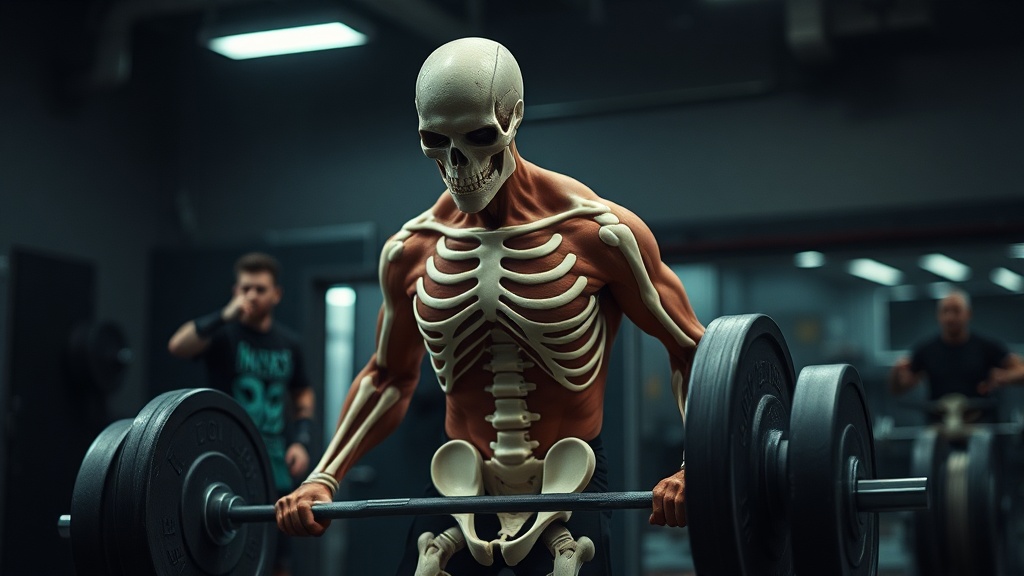
Skeletal Load Capacity: Why Heavy Resistance Training Is Your Best Insurance Policy

Have you ever considered whether your skeletal frame is actually rated for the weight you expect it to carry as you age? This guide covers the mechanics of bone remodeling and explains why high-force resistance training is the only way to prevent the gradual demineralization that starts in your late thirties. Most people focus on muscle or body fat, but your bone density is the true foundation of your physical 'uptime.' If the foundation is brittle, the rest of the system is at risk for a critical failure that no amount of cardio can fix.
To understand how to keep your bones strong, you have to look at them as a living material that follows engineering principles. This is known as Wolff's Law. Basically, bone is deposited where it is needed and resorbed where it isn't. When you subject a bone to a mechanical load, it bends very slightly. This deformation creates a pressure gradient that pushes fluid through the tiny channels in your bone tissue. Your osteocytes—the sensors inside the bone—detect this fluid movement and send out signals to build more bone. If you don't provide that stimulus, the body assumes the bone is 'over-engineered' for its current needs and starts thinning it out to save resources. It is a 'use it or lose it' system that operates on a much longer timeline than muscle growth.
We also need to look at the difference between cortical and trabecular bone. Cortical bone is the hard outer shell that provides most of the structural support. Trabecular bone, also called spongy bone, is the internal lattice found at the ends of long bones and in the vertebrae. Trabecular bone has a much higher surface area, which means it reacts to metabolic changes much faster than cortical bone. This is why the spine and the femoral neck (the hip) are often the first places to show signs of weakness. If you aren't putting significant stress on these specific areas, you are effectively letting your internal scaffolding corrode. Strength training isn't just about looks; it is about maintaining the integrity of this internal lattice so you don't end up with a 'low safety factor' skeleton by age sixty.
How much weight do you actually need to lift to trigger bone growth?
The research on what triggers bone growth—a process called osteogenesis—is quite specific. You can't just move; you have to move against a force that exceeds what is called the 'Minimum Effective Strain.' In engineering terms, this is the threshold where the material begins to experience enough stress to warrant a change in its properties. For the human femur, Mayo Clinic findings and other clinical data suggest that high relative loads are required to see significant increases in mineral density. You aren't going to get that from a light stroll around the neighborhood. You get it from heavy resistance training or high-impact movements. While jumping can provide high forces, it is often hard on the joints of a middle-aged professional. Heavy squats and deadlifts are a more controlled way to hit those force targets without the erratic stress of plyometrics.
Another variable to consider is the 'strain rate.' This is the speed at which the load is applied. Bones are viscoelastic, meaning they behave differently depending on how fast you load them. Fast, dynamic loading generally produces a better osteogenic response than slow, static loading. However, for those of us over forty, we have to balance this with the health of our connective tissues. A heavy lift performed with a fast concentric phase (the 'up' part of the lift) provides a high strain rate while keeping the overall movement controlled. This is the 'engineering fix' for bone health: use weights that are heavy enough to matter and move them with intent. Don't just go through the motions. Every rep is a signal to your body that your bones need to be denser. According to high-intensity loading studies, even people with existing low density can see improvements when the load is high enough.
Why is axial loading different from standard cardio for bone health?
Standard cardiovascular exercise like cycling or swimming is great for your heart, but it does almost nothing for your bones. In fact, professional cyclists often have lower bone density than sedentary people because they spend so much time in a non-weight-bearing state. Axial loading is the key differentiator. This refers to weight that travels through the long axis of your spine and legs. When you perform a barbell squat, the weight sits on your shoulders and compresses your vertebrae, your hips, and your femurs all at once. This compression is a global signal for skeletal reinforcement. Cardio simply doesn't provide this vertical pressure. If you only do cardio, you are building a strong engine on a weak chassis. You need the axial load to ensure the chassis can handle the engine's output.
| Activity | Osteogenic Potential | Primary Load Type |
|---|---|---|
| Swimming | Low | None (Buoyancy) |
| Walking | Moderate-Low | Low Impact |
| Running | Moderate | Impact (1.5-3x BW) |
| Squatting | High | Axial Compression |
We also have to talk about the 'sedentary professional' problem. Most of us spend eight to ten hours a day in a chair. In this position, your skeleton is effectively 'off-duty.' There is no significant load on the spine or the hips. Over years, this lack of input leads to a gradual thinning of the bone lattice. You might be 'fit' in terms of your body fat percentage, but your skeletal architecture could be equivalent to someone much older. This is why strength training is a non-negotiable part of a long-term health protocol. It isn't an 'add-on' for athletes; it is a maintenance requirement for the human frame. You have to counteract those hours of sitting with high-intensity loading sessions that force the body to keep its 'structural insurance' policies up to date.
What are the most effective movements for reinforcing your skeletal frame?
If you want the most value for your time in terms of skeletal health, you have to prioritize compound movements. These are exercises that involve multiple joints and allow for the heaviest loads. The 'Big Three' for bone health are the squat, the deadlift, and the overhead press. The squat targets the hips and spine—the two most vital areas for fracture prevention. The deadlift provides massive tension through the entire posterior chain and requires the spine to stay rigid under heavy load. The overhead press loads the spine and the upper extremities. These movements are the 'gold standard' because they allow for progressive overload. You can start with a weight that is manageable and slowly increase it over months and years, ensuring that the stimulus always stays above the 'Minimum Effective Strain' threshold.
How often should you be doing this? Unlike muscle, which can recover in 48 hours, bone takes longer to remodel. However, the stimulus needs to be consistent. A frequency of two to three sessions per week is usually optimal for most professionals over forty. This allows enough time for the systemic stress to dissipate while still providing frequent enough signals to keep the osteoblasts active. You also don't need to do fifty different exercises. Focus on three to five high-quality movements per session. It is about the quality of the load, not the quantity of the 'burn.' In our world, we call this 'high-signal, low-noise' training. You want to provide a very clear signal to the body that it needs to be stronger, without creating so much fatigue that you can't show up for your job the next day. Harvard Health research supports this focused approach for long-term skeletal durability.
Finally, we should look at the systemic benefits of high-load training. Beyond just the bones, heavy lifting improves the stiffness of your tendons and the strength of your ligaments. It creates a more 'rigid' system in the best possible way. A rigid system is a stable system. When your muscles are strong and your bones are dense, your nervous system feels safer moving through space. This is why people who lift heavy often report fewer 'nagging' injuries. Their body has a higher safety factor. They aren't living at the edge of their structural limits; they have a buffer. Building that buffer is the best investment you can make in your fifties and sixties. It is the difference between being a 'brittle' retiree and being a functional athlete well into your seventh decade.