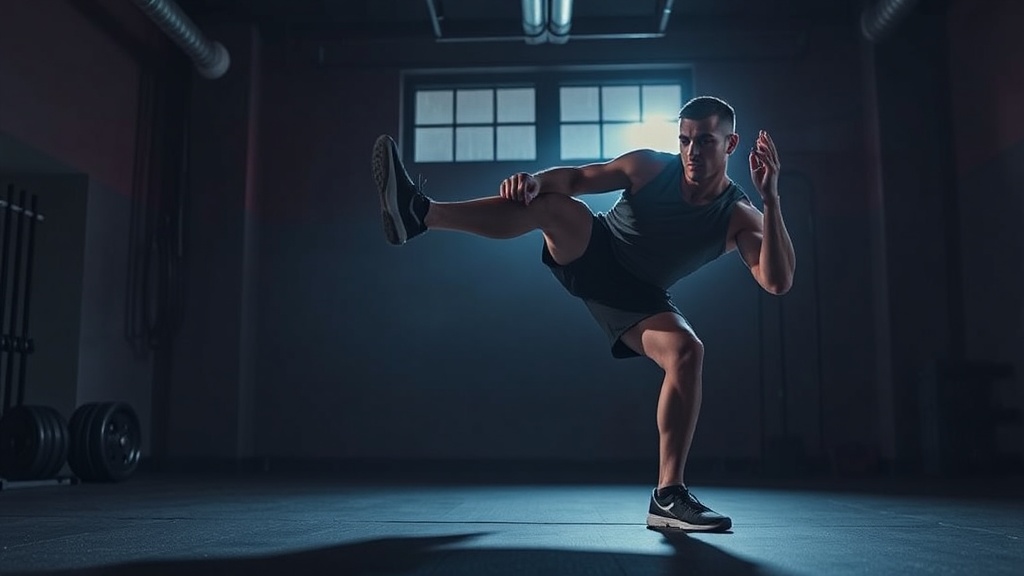
Why You Need to Prioritize Single Leg Stability Training

In this guide, you will learn why single-leg stability training is a critical component of long-term functional strength, the mechanical failures that occur when unilateral training is neglected, and how to implement a systematic approach to building a stable foundation. We will move beyond the superficial goal of "balance" to examine the neurological and structural requirements of unilateral movement.
The Mechanical Necessity of Unilateral Loading
Most traditional strength training programs are built around bilateral movements: the barbell squat, the deadlift, and the bench press. While these are excellent for maximizing absolute load and systemic tension, they often mask significant asymmetries in your kinetic chain. When you stand on two feet, your body can subconsciously shift the load to the stronger side or the more stable limb to compensate for a deficit. This is a form of "structural masking."
Single-leg training forces the body to resolve these asymmetries. When you perform a Bulgarian Split Squat or a Single-Leg Romanian Deadlift (RDL), there is no secondary limb to redistribute the weight. If your left gluteus medius is weak or your right ankle mobility is restricted, the movement will fail or deviate. From an engineering perspective, single-leg training is a stress test for your biological chassis. It identifies the weak links in your system before they lead to a catastrophic failure, such as a fall or a sudden lumbar strain.
As we age, the ability to manage weight on a single limb becomes the primary predictor of functional independence. Whether you are navigating uneven terrain on a hiking trail or simply stepping up into a vehicle, your ability to stabilize your center of mass over a single base of support is paramount. Neglecting this leads to a "brittle" strength profile—one that looks impressive in a controlled gym environment but fails in the unpredictable real world.
The Neuromuscular Component: Proprioception and Reflexive Stability
Stability is not just about muscle strength; it is about the speed and accuracy of your nervous system. Proprioception—the body's ability to sense its position in space—relies on a complex feedback loop between mechanoreceptors in your joints, muscles, and tendons, and your central nervous system. When you train on one leg, you are essentially upgrading your internal sensor array.
During a single-leg movement, your brain must constantly process micro-adjustments. If your ankle begins to roll slightly outward (inversion), your nervous system must trigger the peroneal muscles to correct the position instantly. This is reflexive stability. If you only perform bilateral movements, you are training your "macro" strength but neglecting this "micro" reactionary capacity. Over time, a lack of reflexive stability leads to increased fall risks and chronic joint instability.
This neurological training is particularly important for preventing common injuries like lateral ankle sprains or knee instabilities. By introducing controlled instability, you teach the body to react to perturbations. This is a foundational element of strength training after 40, where maintaining the integrity of your movement patterns is just as important as the load on the bar.
The Three Pillars of Single-Leg Stability
To build a truly stable unilateral foundation, you must address three distinct areas: the ankle complex, the hip/pelvis complex, and the core/trunk integration. If one of these pillars is compromised, the entire movement chain collapses.
1. The Ankle Complex (The Foundation)
The ankle is the first point of contact with the ground. If your dorsiflexion (the ability to pull your toes toward your shin) is limited, your body will compensate by collapsing the arch or shifting the load to the knee and lower back. A stable ankle provides a rigid lever for force production. Exercises like the Single-Leg Calf Raise or practicing balance on a foam pad (such as a Airex pad) can help refine this foundational stability.
2. The Hip and Pelvis (The Engine)
The gluteus medius and the deep hip rotators are responsible for keeping your pelvis level during single-leg stances. If these muscles are weak, your pelvis will drop on the non-weight-bearing side—a movement known as a Trendelenburg gait. This creates a massive shear force on the lumbar spine. Exercises like the Side Plank with Leg Abduction or the Single-Leg Glute Bridge are essential for ensuring the "engine" of your movement remains level and efficient.
3. The Core and Trunk (The Chassis)
Stability is useless if the force cannot be transferred through the torso. A stable core prevents "energy leaks." When you are on one leg, your core must work to prevent excessive lateral flexion or rotation. A strong trunk ensures that the strength generated by your legs is actually utilized for movement rather than lost through a wobbling midsection. This is why a heavy kettlebell carry, like a Turkish Get-Up or a single-arm Farmer's Walk, is an elite tool for integration.
Practical Implementation: A Tiered Approach
Do not attempt to jump straight into heavy, weighted single-leg movements if you cannot maintain a stable pelvis during bodyweight variations. Approach this like a software rollout: start with a stable environment and gradually introduce complexity and load.
Level 1: Static Balance (The Beta Test)
Before adding weight, you must master the ability to hold a position. Focus on these movements to build the baseline neurological pathways:
- Single-Leg Stand: Stand on one leg for 30–60 seconds. Focus on "rooting" your foot into the floor by engaging the big toe, pinky toe, and heel.
- Bird-Dog: This builds cross-body stability and core integration without the high demand of standing.
- Single-Leg Reach: While standing on one leg, reach the opposite foot forward, maintaining a flat pelvis.
Level 2: Dynamic Stability (The Integration Phase)
Once you can hold a static position, introduce movement. This forces the body to stabilize while the center of mass is shifting:
- Step-Ups: Use a 12-inch or 20-inch box. Focus on the eccentric (lowering) phase. Do not "plop" down; control the descent with total tension.
- Split Squats: These are less demanding than Bulgarian Split Squats but excellent for building foundational knee and hip stability.
- Single-Leg RDL (Bodyweight): Focus on the hinge at the hip while keeping the spine neutral and the hips square to the ground.
Level 3: Weighted Unilateral Strength (The Production Phase)
This is where you build actual force production. These movements should be treated as primary lifts in your program:
- Bulgarian Split Squats: Elevate your rear foot on a bench. This is one of the most effective ways to build unilateral quad and glute strength.
- Weighted Single-Leg RDL: Hold a kettlebell or a dumbbell in the hand opposite to the standing leg. This creates a rotational challenge for the core.
- Single-Arm Kettlebell Press: While standing on one leg, perform an overhead press. This integrates the entire kinetic chain from the foot to the shoulder.
The Programming Protocol
To see results, you cannot treat single-leg work as an afterthought or a "finisher" at the end of a workout when you are already fatigued. Fatigue increases the risk of poor mechanics. Instead, integrate these movements into the main body of your training sessions.
Frequency: Aim to include at least two unilateral exercises in every strength session. You can alternate between "Push" unilateral moves (Split Squats) and "Pull" unilateral moves (Single-Leg RDLs).
Volume and Intensity: For stability-focused work, higher repetitions (10–15 reps) with moderate weight are often more effective for neurological adaptation. For pure strength-focused unilateral work, lower repetitions (6–8 reps) with heavier loads can be used once your stability is established.
"Stability is the prerequisite for power. You cannot build a high-performance engine on a chassis that cannot handle the torque."
By prioritizing single-leg stability, you are not just training for aesthetics; you are engineering a body that is resilient, adaptable, and capable of handling the stresses of aging and physical activity. Treat your stability work with the same rigor as your heavy compound lifts, and your future self will thank you.